Prediction Models for Unplanned Removal of Peripherally Inserted Central Catheters and Their Risk Factors: A Narrative Review
Article information

Abstract
Background
While peripherally inserted central catheters (PICCs) are widely used for medium- to long-term venous therapies, complications such as infection, venous thrombosis, occlusion, and dislodgement frequently lead to unplanned removal before treatment completion. This review aimed to describe prediction models for unplanned PICC removal and its precipitating complications in adults, focusing on their methodological characteristics, retained predictors, and the extent of external validation.
Methods
This narrative review followed a structured literature search across PubMed, Scopus, and Google Scholar for articles published from database inception to August 2026, using keywords related to PICCs, unplanned removal, complications, risk factors, and prediction models in adults. Studies were categorized according to whether the predicted outcome was unplanned removal itself or a precipitating complication, and were narratively synthesized.
Results
Fourteen prediction-model studies were included; 3 predicted removal itself and 11 predicted a removal-precipitating complication, most commonly venous thrombosis. The predictors retained in the final models were distributed multidimensionally across the patient, catheter, and treatment/management domains; elevated D-dimer, a history of venous thromboembolism, and the number of catheter lumens recurred most consistently, whereas the direction of catheter material and valve type was inconsistent between models that used different outcome definitions. None of the three models targeting removal itself retained the number of lumens, all three were developed in single centers, and only one was externally validated.
Conclusions
The value of predictors and prediction models is realized through risk-based monitoring; because much of this monitoring is performed by nurses, integrating catheter placement, prediction models, and risk-factor-based patient monitoring into the nursing workflow is proposed as a direction for future research and practice. No included study evaluated the clinical effect of such integration, which therefore remains to be demonstrated.
INTRODUCTION
A peripherally inserted central catheter (PICC) is a central venous access device that is typically inserted through the brachial or basilic vein and positioned with its tip at the cavoatrial (superior vena cava–right atrium) junction. Because it can be placed at the bedside under ultrasound guidance, carries a lower risk of insertion-related mechanical complications such as pneumothorax and hemothorax than centrally inserted central catheters (CICCs), and allows medium- to long-term maintenance including outpatient and home settings, its use has continued to expand in chemotherapy, parenteral nutrition, and long-term intravenous antibiotic therapy [1-3]. In particular, some studies have reported that PICCs may be advantageous over CICCs with respect to bloodstream infection [4,5].
However, PICCs are accompanied by various complications throughout the period from insertion to removal, including central line-associated bloodstream infection, deep vein thrombosis/venous thromboembolism, occlusion, dislodgement, malposition, and insertion-site bleeding [6-8]. In particular, a systematic review reported that the risk of venous thrombosis is relatively high compared with that of other central venous catheters [9]. These complications impose not only a physical but also a psychological and economic burden on patients [10,11], and many of them culminate in unplanned removal, in which the catheter is removed before the completion of the planned treatment [6].
Unplanned removal of a PICC is a representative patient-safety problem that leads to interruption and delay of ongoing treatment, additional risk and cost from reinsertion, secondary infection and thrombosis, and prolonged hospitalization [12,13]. Across several cohorts, PICC failure rates have been reported to reach approximately 15%–30%; a trial protocol on dressing and securement cites a failure rate of about 30% drawn from earlier work [14], and a prospective study of cancer patients reported removal-associated failure of about 15% [15]. In an adult multicenter cohort, the incidence of unplanned removal was about 10% [13,16], and early removal within 5 days of insertion reached about 19% [12]. Therefore, the early detection and prevention of these complications to ensure the catheter remains securely in place until the completion of therapy constitute a critical clinical challenge.
In this context, clinical prediction models have been actively developed to identify high-risk patients early and enable the efficient allocation of monitoring and nursing intervention resources [17-19]. Nonetheless, existing literature reviews remain limited to individual complications [20], failing to deliver comprehensive evidence encompassing both direct catheter removal and catheter failure within the framework of catheter maintenance. Moreover, with many existing models confined to the initial development stage, the degree to which external validation and model robustness have been verified across diverse clinical environments has yet to be thoroughly examined. A comprehensive review of prediction models for unplanned catheter removal and their leading complications—while critically appraising their methodological rigor and external validation status—is essential for establishing dependable decision-support tools in clinical practice. The purpose of this review is, in adult PICC patients, to (1) examine the methodological features and performance of models predicting unplanned removal and its precipitating complications, (2) characterize the distribution of the predictors retained in these models across the patient, catheter, and treatment/management domains.
METHODS
This narrative review summarized the literature on prediction models for unplanned PICC removal and its precipitating complications in adults. PubMed and Scopus were searched between August 11 and 16, 2026, with the final search conducted on August 16, 2026. The search covered all records indexed from database inception through that date, with no restriction on publication year. Data extraction was performed by a single reviewer, and no independent cross-validation of the extracted data was conducted. Search terms included “peripherally inserted central catheter,” “PICC,” “unplanned removal,” “unplanned extubation,” “premature removal,” “early removal,” “dislodgement,” “catheter failure,” “risk factor,” “prediction model,” “predictive model,” “nomogram,” and “machine learning.” Google Scholar was also used as a supplementary search source during the same period. In addition, the reference lists of included studies and relevant reviews were manually searched to supplement the database search. (n=6,276). Records retrieved from the two databases were merged and duplicates were removed (n=787), after which 5,489 records underwent title and abstract screening.
Studies were eligible if they involved adult patients aged 18 years or older with a PICC and developed or validated a model predicting removal of the catheter—including accidental dislodgement, early or premature removal, and catheter failure—or one of its precipitating complications such as bloodstream infection, venous thrombosis, and occlusion. Whether a study had in fact developed or validated a prediction model was determined at the screening stage rather than by the search itself. Studies that reported risk-factor associations without constructing a prediction model, reports limited to pediatric or neonatal populations, records for which only an abstract was available without accessible full text (e.g., conference abstracts), and non-research publications such as reviews, editorials, comments, and case reports were excluded (n=5,457). We then assessed whether the remaining studies had actually developed a prediction model. Studies that reported only risk factors and statistical significance without developing a prediction model were excluded (n=18). Ultimately, 14 studies were included in the review and are summarized in Table 1.
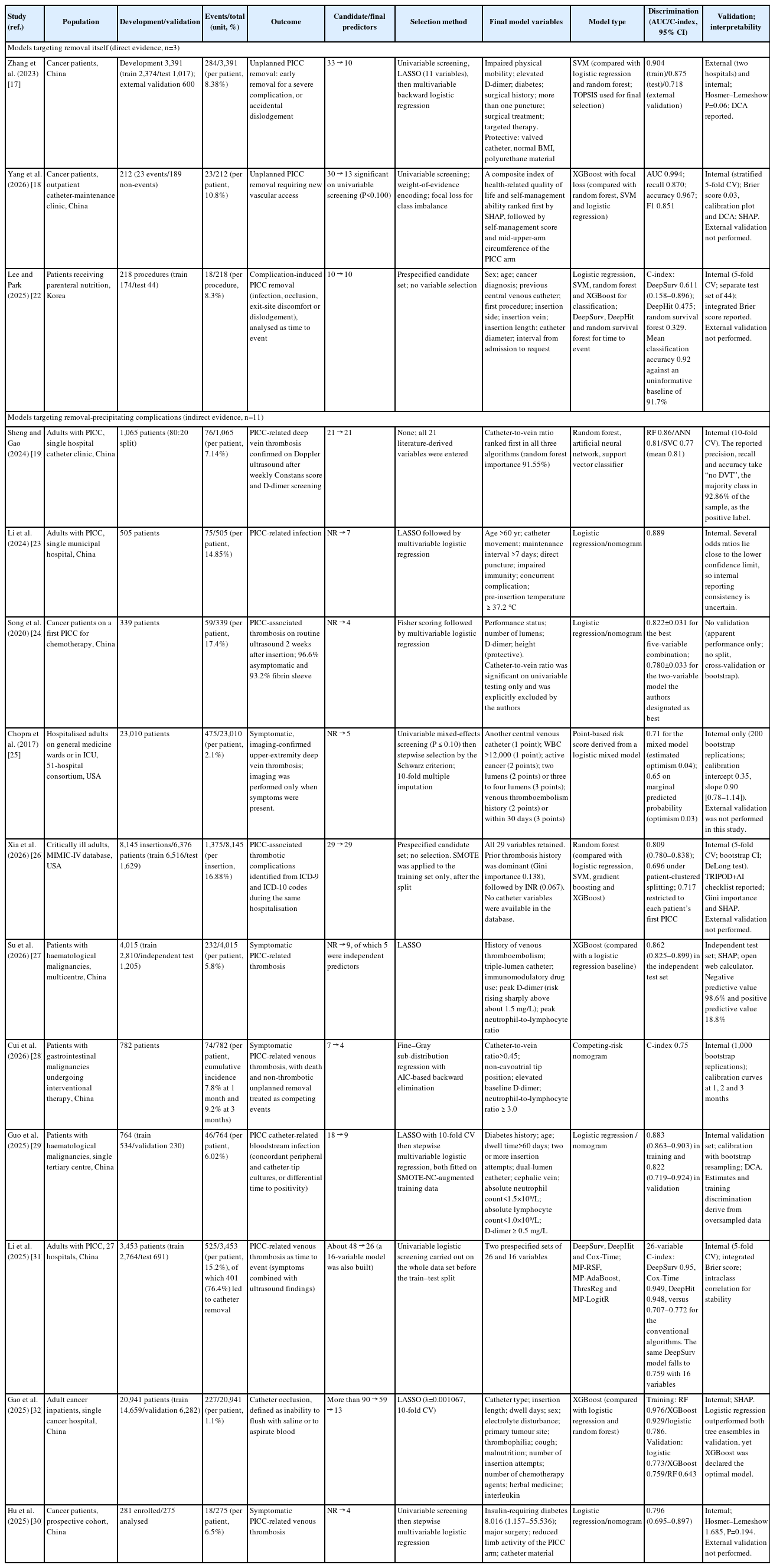
Characteristics of the included prediction-model studies (n=14), by outcome category
RESULTS
Fourteen prediction-model studies were included. Three took removal itself as the prediction target (direct evidence) and 11 targeted a removal-precipitating complication (indirect evidence). Characteristics of the included studies are summarized in Table 1.
Definition and incidence of unplanned removal
Across the literature, the terms denoting unplanned removal varied—unplanned removal, “unplanned extubation”, premature/early removal, dislodgement, catheter failure, and removal due to complication—and their operational definitions were inconsistent [13,16,17]. Some studies addressed only removal forced by complications, whereas others included accidental dislodgement or early removal unrelated to complications. For example, one retrospective study defined early removal as removal within 5 days of insertion for reasons other than a PICC complication [12].
Incidence also varied widely by definition and population. In an adult multicenter prospective cohort, the incidence of unplanned removal was about 10% [13], and early removal within 5 days was reported at about 19% [12]. In a prospective study of cancer patients, removal-associated PICC failure was about 15%, with reasons including upper-extremity deep vein thrombosis, bloodstream infection, exit-site infection, dislodgement, and occlusion [15]. A trial protocol on dressing and securement cites, as background rather than as its own result, a PICC failure rate of about 30% owing to vascular, infectious, or mechanical complications [14], which indicates that unplanned removal is a common causal endpoint of these complications. Spontaneous dislodgement, when analyzed as a separate endpoint, occurred in about 4% of PICCs over 60,894 catheter-days in an oncology cohort [21]. The operational definition and the unit of observation—patient, catheter, or catheter-days—differed across studies and account for a substantial part of this variation. These incidence estimates are drawn from cohort studies cited here as background; the outcome definition, follow-up unit, and event count of every included prediction-model study are reported in Table 1.
Prediction models for unplanned removal and related complications
Fourteen studies developed or validated a prediction model (Table 1). Of these, three took removal itself as the prediction target, whereas eleven targeted a precipitating complication—most commonly venous thrombosis. Across the fourteen studies, the predictors retained in the final models were distributed over the patient, catheter, and treatment/management domains rather than concentrated in any one of them.
Models targeting removal itself
Three models took removal itself as the prediction target. One prospective study selected architectures by combining univariate analysis, least absolute shrinkage and selection operator, and multivariable analysis, adopted a support vector machine (SVM) as the final model, and is the only model in this review to have been externally validated in separate hospitals [17]. A second study combined multiple machine-learning algorithms with SHapley Additive exPlanations (SHAP)-based interpretation and proposed that a composite index combining health-related quality of life and self-management ability was the most influential predictor, emphasizing the importance of patient-driven factors beyond traditional clinical and laboratory variables [18]. A third study, in patients receiving parenteral nutrition, defined complication-induced removal as the event and applied both classification algorithms and survival-based deep learning to it [22].
All three were developed in single centers. In two of them the number of events was very small relative to the number of candidate predictors, so the headline performance figures are difficult to interpret: in one, the reported classification accuracy is close to what would be obtained by predicting no event for every patient, whereas the discrimination of the corresponding time-to-event model was substantially lower and its confidence interval very wide [18,22]. The number of models targeting removal has therefore increased, but the evidence supporting them has not.
The predictors retained in these three models were concentrated in the patient and catheter domains, with little overlap between them. In the patient domain, impaired physical mobility, elevated D-dimer, diabetes, and a history of surgery were retained in the externally validated model [17], whereas the model developed in an outpatient catheter-maintenance clinic retained a composite index of health-related quality of life and self-management ability as its most influential variable by SHAP, followed by the self-management score itself and the mid-upper-arm circumference of the PICC-bearing arm [18]; sex, age, cancer diagnosis, and a previous central venous catheter were prespecified in the parenteral-nutrition model [22]. In the catheter domain, the retained variables described the insertion procedure as much as the device: more than one puncture attempt increased risk, whereas a valved catheter, a normal body mass index, and polyurethane material were protective [17], and insertion side, insertion vein, insertion length, catheter diameter, and whether the procedure was the first were entered without variable selection [22]. Treatment- and management-related predictors were limited to surgical treatment, targeted therapy [17], and the interval from admission to the insertion request [22]. Notably, none of the three models retained the number of catheter lumens, and D-dimer was the only laboratory marker retained in any of them.
Models targeting removal-precipitating complications
Many traditional prediction studies used logistic regression and nomograms to predict PICC-related bloodstream infection or venous thrombosis [23,24]. Representatively, the Michigan Risk Score predicts PICC-related thrombosis using a five-variable scoring system—presence of another central venous catheter, leukocytosis, multi-lumen PICC, a history of deep vein thrombosis, and active cancer—and was internally validated by bootstrap resampling, with external validation left to subsequent work [25]. Machine-learning studies compared various algorithms, including logistic regression, SVM, random forests, and gradient boosting; one such study combined patient features and catheterization-technology features to predict PICC-related deep vein thrombosis [19].
Modeling approaches in this group have diversified rapidly in recent years. Reported developments include machine-learning models built on a large intensive-care database and reported in accordance with TRIPOD+AI [26]; a dynamic multicentre model with an independent test set in patients with haematological malignancies [27]; a competing-risk nomogram in which non-thrombotic unplanned removal and death were explicitly treated as competing events [28]; nomograms for catheter-related bloodstream infection [29] and prospectively derived models for symptomatic thrombosis [30]; survival-based deep-learning models [31]; and gradient-boosting models for catheter occlusion with SHAP-based interpretation [32].
Across the eleven models targeting a precipitating complication, coagulation and inflammatory markers were the predictors retained most frequently. An elevated D-dimer was retained in models of thrombosis and of bloodstream infection alike [24,27-29], and the neutrophil-to-lymphocyte ratio, leukocytosis, and absolute neutrophil and lymphocyte counts were retained in several others [25,27-29]. A history of venous thromboembolism recurred repeatedly and was the dominant variable in the intensive-care model, in which prior thrombosis carried the highest importance and the international normalised ratio ranked second [25,26,27]. Older age, diabetes, active malignancy, and impaired immunity were retained across outcome types [23,25,29,30], as were disease- and nutrition-related characteristics such as performance status, primary tumour site, thrombophilia, and malnutrition [24,32]. Functional and patient-reported characteristics appeared only once, as reduced activity of the catheter-bearing limb [30].
In the catheter domain, the number of lumens was the most consistently retained predictor, with multi-lumen catheters carrying increased risk in models of bloodstream infection and of thrombosis [24,25,27,29] and with a graded effect in the Michigan Risk Score, which scored two lumens and three to four lumens separately rather than dichotomizing them [25]. The catheter-to-vein ratio ranked first among all variables in one machine-learning model and was retained as a dichotomized threshold above 0.45 in a competing-risk nomogram [19,28], yet another nomogram excluded it explicitly despite univariable significance [24]. Tip position, insertion vein, insertion length, dwell time, and the number of puncture attempts were retained in several models [28,29,32], whereas catheter material and catheter type entered without a comparable reference category or directional interpretation [30,32]. The largest database-derived model contained no catheter variables at all, because none were recorded in the source database [26]. Treatment- and management-related predictors were fewer and were concentrated in the models of infection and of occlusion: catheter movement, a maintenance interval longer than 7 days, direct puncture, and a pre-insertion temperature of 37.2 °C or higher [23]; the number of chemotherapy agents and herbal medicine use [32]; immunomodulatory drug use [27]; and recent major surgery [30]. These management variables were retained less frequently than laboratory values and were operationalized inconsistently across studies.
Model performance, validation, and interpretability
The discrimination of the included models was generally in the range of 0.7–0.9 by area under the curve (AUC) or concordance index (C-index), and some models also presented calibration and decision-curve-analysis results [23-25]. However, external validation in a separate cohort was performed in only one study [17], and many had limitations such as single-center, retrospective designs, small samples, and an insufficient number of events per variable. Although the adoption of interpretability techniques such as SHAP has recently increased [18], the completeness of reporting remained limited, with sensitivity and specificity often not reported. More recent studies show partial improvement—explicit adherence to reporting guidance for prediction models [26], prespecified predictors with bootstrap internal validation [28], and independent test sets [27]—but external validation in a separate cohort remains uncommon, and this improvement has occurred almost entirely among models targeting complications rather than removal.
DISCUSSION
In this study, we confirmed that unplanned removal of PICCs is not a single event but a complex event to which heterogeneous complications—venous thrombosis, bloodstream infection, dislodgement, and occlusion—commonly converge [6,15,16]. For this reason, the predictors retained in models of unplanned removal and its precipitating complications are also distributed in a complex manner across the patient, catheter, and treatment domains, and prediction research has tended to focus on the individual precipitating complications rather than on removal itself.
This distinction has direct implications for the interpretation of the evidence. Predictors derived from models of thrombosis or bloodstream infection identify patients at risk of developing a complication, but they do not necessarily identify patients whose catheter will be removed, because whether a complication leads to removal depends further on institutional protocols, clinician judgment, and the availability of alternative venous access. Models targeting precipitating complications should therefore be regarded as indirect surrogates rather than as direct evidence for unplanned removal. One recent competing-risk analysis makes this separation explicit by treating non-thrombotic unplanned removal as a competing event rather than as censoring [28].
Among the predictors retained in the included models, the number of catheter lumens was the most consistent: a higher number of lumens was associated with greater risk in models of bloodstream infection and of thrombosis, across different populations and outcome definitions [24,25,27,29], and the same pattern is reported in cohort studies of unplanned removal [13] and of its precipitating complications [20,33]. Elevated D-dimer, a history of venous thromboembolism, older age, diabetes, and active malignancy were likewise retained repeatedly [17,24-27,29]. By contrast, several widely cited factors were not consistent. Catheter material and valve type entered the models with different reference categories and opposite directions across populations and catheter products [17,30,32], and the same instability is evident in the large multicenter cohorts from which candidate variables are commonly drawn [13,16,34]. The insertion side was not retained in any of the models reviewed here and showed no association in the cohort studies that used symptomatic, imaging-confirmed thrombosis as a single endpoint [25,34-36]. Dwell time was retained as a predictor in some models [29,32] but was unrelated to any complication in one prospective cohort [8] and was assessed without multivariable adjustment in another [37]. Much of this inconsistency arises from differences in outcome definitions and in the covariate sets entering variable selection, which together act as a fundamental constraint that hampers the comparison and integration of predictors across models.
In addition, prediction-model studies of unplanned PICC removal revealed several common limitations. First, the heterogeneity of outcomes is prominent. Because many models conflate removal with its precipitating complications such as thrombosis and infection, models that directly predict removal itself remain few [17,18,22], and only one of them has been externally validated [17]. Adding the recently published studies raised this number only from two to three; all the other newly identified models targeted thrombosis, bloodstream infection, or occlusion [26-32]. The more consequential limitation is therefore not the count but the evidence behind it: all three removal-targeting models were developed in single centers, and only one has been tested outside its development setting. Second, the risk of methodological bias is high. Retrospective designs, small samples, an insufficient number of events per variable, arbitrary categorization of continuous variables, the absence of external validation, and non-reporting of sensitivity and specificity are repeatedly observed [19,23,24]. The heterogeneity of variable selection compounds this: because candidate sets and reduction methods differed so widely across studies, and in one case selection preceded the train–test split, the retained predictors partly reflect the analytic pipeline rather than the underlying clinical mechanism. Third, these problems ultimately limit the reproducibility and generalizability of the models.
The clinical value of such predictors and prediction models is realized only when they are linked to monitoring. Stratifying patients by risk allows monitoring resources to be allocated in proportion to the level of risk. That is, risk-based and targeted monitoring becomes possible—applying intensive monitoring, such as insertion-site inspection, dressing checks, symptom screening, and ultrasound surveillance where necessary, to high-risk patients, and relatively light monitoring to low-risk patients. This represents a shift away from a reactive approach that responds only after a complication has occurred, toward proactive care that detects complications early, before they lead to removal.
Furthermore, such monitoring may support a more individualized and patient-centered approach when it is tailored to each patient’s risk profile. For example, thrombosis surveillance may be prioritized for patients with cancer, elevated D-dimer levels, or multi-lumen catheters, whereas monitoring for dislodgement and related education may be emphasized in patients with limited physical activity or low self-management ability. In particular, the finding that a composite index combining quality of life and self-management ability was a strong predictor of unplanned removal [18] suggests that monitoring strategies should consider not only clinical and laboratory variables but also patient-reported outcomes and functional characteristics [10].
In this context, nursing practice represents an important point of integration for risk-based monitoring because nurses are closely involved in routine post-insertion assessment, including observation of the insertion site, dressing condition, catheter patency, symptom changes, and patient education. Prediction models may therefore have potential value in supporting more individualized monitoring within routine care. However, whether such models can be effectively incorporated into clinical nursing workflows, and whether their use improves monitoring processes or patient-related outcomes, remains to be established. Future implementation and impact studies are needed to evaluate their feasibility, acceptability, workflow integration, and clinical utility in real-world practice.
Limitations
This review has several limitations. First, the review was restricted to two bibliographic databases and to English-language publications. Second, screening and data extraction were performed by one reviewer, the review was not prospectively registered, and a formal risk-of-bias assessment such as PROBAST was not conducted. Third, marked heterogeneity in outcome definitions, populations, and analytic approaches precluded quantitative synthesis, so all findings are presented descriptively and no ranking of predictors or models by strength of evidence is implied.
Conclusion
Unplanned removal of PICCs is an important clinical problem that threatens treatment continuity and patient safety, and the predictors retained in existing models are distributed multidimensionally across the patient, catheter, and treatment/management domains. Current prediction research is concentrated mainly on the individual precipitating complications, such as venous thrombosis and bloodstream infection, and studies that directly predict and externally validate removal itself remain few. Integrating prediction- and risk-factor-based monitoring into the nursing workflow represents a plausible next step, but no included study evaluated its effect on patient outcomes, and whether such integration reduces unplanned removal remains to be demonstrated. Future work should prioritize standardized outcome definitions; prospective, multicenter studies with adequate event numbers; externally validated and interpretable models that take removal itself as the prediction target; and implementation studies evaluating model-guided nursing monitoring against removal-related outcomes.
Notes
AUTHOR CONTRIBUTIONS
Dr. Jeong Yun PARK had full access to all of the data in the study and takes responsibility for the integrity of the data and the accuracy of the data analysis. All authors reviewed this manuscript and agreed to individual contributions.
Conceptualization: SML and JYP. Data curation: SML. Formal analysis: SML and JYP. Investigation: SML. Methodology: SML and JYP. Software: SML. Validation: SML and JYP. Writing–original draft: SML. Writing–review & editing: JYP.
CONFLICTS OF INTEREST
Jeong Yun PARK is the Ethics Editor of this journal and was not involved in the peer review or editorial decision-making process for this article. No other potential conflicts of interest relevant to this article were reported.
FUNDING
The study was conducted with the support of the 2023 Health Fellowship Foundation.
DATA AVAILABILITY
The data presented in this study are available upon reasonable request from the corresponding author.