Knowledge, Attitudes, and Practices Regarding Antenatal Care among Women in High-Risk Areas of El Salvador: A Baseline Survey for Future Program Evaluation
Article information

Abstract
Background
Despite substantial improvements in maternal health indicators and near-universal institutional delivery coverage in El Salvador, limited evidence is available regarding maternal health literacy and health-seeking behaviors among women residing in socioeconomically vulnerable and geographically isolated communities. This study aimed to establish baseline evidence on knowledge, attitudes, and practices related to antenatal care and maternal health among women living in high-risk municipalities of El Salvador.
Methods
A cross-sectional baseline survey was conducted between June 2 and June 26, 2025, among 304 pregnant and postpartum women receiving care from five family community health units (UCSFs) located in high-risk municipalities of El Salvador. Data were collected using a structured 75-item questionnaire administered through KoBoToolbox. Descriptive statistics, Mann-Whitney U-tests, Pearson’s chi-square tests, and Spearman correlation analyses were performed.
Results
Although antenatal care utilization was high (96.4%) and institutional delivery was nearly universal among multiparous women (97.5%), substantial gaps in technical maternal health knowledge were identified. Only 25.0% of participants demonstrated adequate knowledge regarding essential prenatal tests, and only 18.1% correctly identified the benefits of both iron and folic acid supplementation. Educational attainment was significantly associated with knowledge of prenatal tests and contraception (both P<0.001), whereas age was not associated with any knowledge indicator. Significant knowledge–practice gaps were observed, particularly regarding contraception (χ2=14.6, P=0.002) and tetanus vaccination (P=0.847), suggesting the presence of structural barriers beyond individual awareness. Territorial disparities of up to 25 percentage points were observed across participating facilities.
Conclusions
High coverage of antenatal care services does not necessarily translate into adequate maternal health knowledge or optimal preventive practices. The findings identify priority areas for maternal health education and service-delivery strengthening and provide important baseline evidence for future monitoring and evaluation of maternal health interventions in vulnerable communities of El Salvador.
INTRODUCTION
Maternal mortality remains one of the most sensitive indicators of global health inequity. In 2023, more than 700 women died daily from preventable pregnancy-related causes, and although the global maternal mortality ratio (MMR) fell by nearly 40% between 2000 and 2023, more than 90% of these deaths occurred in low- and lower-middle-income countries [1]. The main direct causes—hemorrhage, hypertensive disorders, sepsis, and infection—are largely preventable through timely antenatal, intrapartum, and postpartum care [2], yet translating this knowledge into effective practice remains a challenge where geographical, socioeconomic, and cultural barriers converge.
In Latin America and the Caribbean, hypertensive disorders represent a high proportion of maternal death causes [2]. El Salvador has achieved significant reductions in its MMR, from approximately 170 per 100,000 live births in 2000 to 42.8 in 2020, attributed in part to Maternity Waiting Homes and institutionalization of childbirth. However, challenges persist: 99.8% of deliveries are attended by skilled personnel, but coverage of four or more antenatal care visits only reached 82% in 2018, with significant territorial gaps between urban and rural areas.
The knowledge, attitudes, and practices (KAP) framework has proven to be a valuable methodological tool for diagnosing the cognitive, attitudinal, and behavioral dimensions that mediate between service availability and effective utilization [3,4]. KAP studies in low- and middle-income countries have consistently documented the knowledge-practice gap: in India, Bashir et al. [3] found that 96% of women had adequate knowledge but only 58.5% had adequate practices; in Rwanda, only 23.1% exhibited good practices despite 61.2% having adequate knowledge; in Somalia, 86.5% knew about antenatal care services but only 17% complied with the recommended frequency of visits [5]. Associated factors include educational level, age, parity, family structure, and health system barriers [3-6].
Despite advances in maternal health indicators in El Salvador, empirical evidence on KAP in antenatal care remains limited in rural and peri-urban communities. The five selected family community health units (UCSFs) are in municipalities with high obstetric risk, geographical isolation, and unfavorable socioeconomic determinants. Key aspects such as knowledge about prenatal tests, adherence to iron and folic acid, tetanus vaccination, and contraception have received insufficient attention [7]. In particular, the gaps between what women know and what they actually practice have not been documented.
The present study is part of the Korea International Cooperation Agency (KOICA)-supported project entitled “Strengthening the Maternal-Neonatal Emergency Transport System in Remote High-Risk Areas of El Salvador,” implemented by Soonchunhyang University Hospital and local partners.
Accordingly, the findings presented here should be interpreted as baseline evidence reflecting the pre-intervention situation of women residing in high-risk communities. The results are intended to inform program planning, identify priority areas for intervention, and provide a reference point for future endline assessments and impact evaluations.
Despite these advances, empirical evidence on KAP related to antenatal care in El Salvador remains scarce and limited in scope. A 2018 cross-sectional survey of 207 pregnant and postpartum women attending three intermediate UCSFs reported that only about one quarter reached an acceptable level of knowledge of puerperal danger signs [8], and a national review found that women held general reproductive health knowledge while lacking specific risk-recognition skills [9]. To our knowledge, no previous study in the country has combined simultaneous measurement of the three KAP dimensions, systematic disaggregation across multiple primary care facilities, statistical quantification of knowledge–practice gaps in defined clinical domains, and a baseline design with a pre-planned second measurement round. Knowledge of prenatal tests, adherence to iron and folic acid supplementation, tetanus vaccination, and contraception have received particularly limited attention in these settings.
The specific objectives were therefore: (1) to assess baseline levels of KAP on antenatal care and maternal health; (2) to identify sociodemographic determinants of knowledge; (3) to quantify knowledge-practice gaps and territorial disparities; and (4) to establish a benchmark for future evaluation of maternal health programs in vulnerable populations.
METHODS
Study design
A descriptive cross-sectional baseline study with a KAP approach to antenatal care and maternal health was conducted. Data collection took place between June 2 and 26, 2025. This design was intended to establish baseline levels before subsequent program implementation; therefore, it does not directly estimate improvement or intervention effectiveness.
Context and study sites
The study was conducted in five UCSFs located in municipalities prioritized for high obstetric risk and socioeconomic vulnerability: Guaymango (Ahuachapán), Perquín (Morazán), Panchimalco (San Salvador), Puerto de La Libertad (La Libertad), and San Juan Nonualco (La Paz). Selection considered: (a) high rates of maternal and neonatal mortality, (b) geographically remote location, and (c) significant population of women of childbearing age.
Participants and eligibility criteria
Women aged ≥19 years, pregnant or with delivery in the last 12 months, active users of participating UCSFs, who provided informed consent were included. Women under 19 years and those who did not consent were excluded.
The target population of this study was therefore women who are in active contact with the participating UCSFs, rather than all women of reproductive age residing in the five municipalities. Women living in these territories who do not attend the facilities and are not registered by community health promoters were not represented in the sampling frame and could not be reached by either recruitment modality.
Sample size and sampling
The target sample size of 300 participants per survey round was established a priori in the project’s terms of reference, which specify two rounds of 300 analysis units each. Given that predetermined size, the corresponding precision was derived using the finite population formula for a proportion, n=N·Z2·p·q / [Z2·p·q + (N–1)·e2], with N=71.110 women of reproductive age served by the participating facilities, Z=1.96 and P=0.50; the resulting margin of error is 5.66% for n = 300 and 5.61% for the 304 participants actually enrolled. A value of P=0.50 was adopted because no local prevalence estimates were available for the outcomes of interest and because the six knowledge indices span proportions from 4.3% to 99.3%, so that no single expected prevalence would have been appropriate; P=0.50 maximizes the required sample size and is therefore the conservative choice. The finite population correction is negligible at this order of magnitude: assuming population values between 35,000 and 1,000,000 alters the required sample size by fewer than three participants.
The five UCSFs constituted the sampling strata, with equal allocation of 60 questionnaires per facility. Equal rather than proportional allocation was chosen deliberately to preserve statistical power for between-facility comparisons, which were a primary objective of the study. No design effect was applied, as participants were selected directly within each stratum without intermediate clustering stages. One consequence of equal allocation should be noted: because the populations served by the five facilities differ substantially in size, the pooled percentages reported throughout the Results are unweighted summaries across sites and estimate the average across facilities rather than a population-weighted parameter for the combined territory. The final sample comprised 304 women (101% of target): Guaymango (n=60), Perquín (n=60), Panchimalco (n=60), Puerto de La Libertad (n=63), and San Juan Nonualco (n=61).
Data collection instrument
A structured 75-item KAP questionnaire was used, organised in five modules: (I) sociodemographic data, (II) obstetric history, (III) knowledge, (IV) attitudes, and (V) practices. Item content was based on World Health Organization (WHO) conceptual frameworks for antenatal care [10] and on the national Born with Care Law [11]. The questionnaire was developed directly in Spanish, the language of the study population, and administered in Spanish; it is not an adaptation of an instrument validated in another language, and no translation or back-translation procedure was therefore involved. Item wording reproduced in the Supplementary Material 1 is a translation prepared for reporting purposes only. Data were captured digitally using KoBoToolbox.
Content validity was assessed through qualitative review by 2 maternal health specialists of the Ministry of Health of El Salvador; a quantitative content validity index was not computed. The instrument was subsequently pilot tested with 7 women at a UCSF not included in the study sample; the Pilot Test was carried out on Wednesday, March 12, 2025, in coordination with the Ministry of Health, at the Nejapa Health Unit, Nejapa district, San Salvador department; pilot participants were not included in the final sample of 304. Following the pilot study, the attitudes response scale was revised by removing the neutral midpoint to reduce central-tendency responses and improve response discrimination in a population with predominantly basic educational attainment. The codes of the remaining categories were retained, which is why the response codes are non-consecutive.
Attitudes were assessed with 12 items on a four-point Likert scale (1=strongly agree, 2=agree, 4=disagree, 5=strongly disagree; no neutral category), organized into five thematic blocks: value of antenatal care (C28, C29, C31), clinical procedures and screening (C32, C33, C34), nutrition and supplementation (C35, C36), risk behaviours during pregnancy (C39, C40), and safe delivery and reproductive health (C38, C42). Item C38 is negatively worded and was reverse-coded prior to analysis. Cronbach’s alpha was 0.922 for the full 12-item scale and 0.917, 0.926, 0.822 and 0.969 for the first four blocks respectively; the fifth block comprises two items addressing independent domains that do not form a unidimensional scale (r=0.080), and these are reported individually. The blocks represent a thematic organization of the questionnaire rather than psychometrically distinct dimensions: principal components analysis indicated an essentially unidimensional structure, with the first component accounting for 62.3% of the variance.
Data collection
Fieldwork between June 2 and 26, 2025, with two modalities: (a) administration at UCSFs during antenatal consultations, and (b) home visits with community health promoters. The questionnaire was administered face-to-face by trained interviewers, with digital capture via KoboToolbox and field supervision.
Variables and measurements
Knowledge was assessed through six categorical indices. Three indices derived from multiple-response items (reasons for antenatal care, essential prenatal tests, and contraceptive methods) were categorized into four levels: no knowledge, low, partial and high. The numerical thresholds defining each level differ across these indices because their score ranges are not equivalent (0 to 4 for the first two and 0 to 7 for contraception); the specific rules are given in Supplementary Material 1. The iron and folic acid index was categorized into three levels (no knowledge, partial and high), since the underlying item admits only two correct reasons and a fourth level is not constructible. Two indices (early initiation and safe place of delivery) are binary by construction and were classified as adequate or inadequate. Where results are aggregated, “partial or high knowledge” denotes a score of 2 or above on the four-level indices. The prenatal tests index measures recognition of four pre-specified tests rather than knowledge of antenatal testing as a whole; responses recorded under the item’s open-ended option were not incorporated into the score. Full item wording, scoring rules and categorization thresholds are provided in Supplementary Material 1.
Two of the six indices (early initiation and safe place of delivery) are based on items phrased as normative endorsement rather than as factual recall, and overlap conceptually with two items in the attitudes block (C31 and C38 respectively). They are reported as knowledge indices for consistency with the questionnaire structure, but are distinguished throughout from the four indices assessing technical content, with which they show no consistent association.
The knowledge-practice gap analysis was restricted to selected domains according to three criteria: the knowledge index had to assess technical content rather than normative endorsement, so that the notion of a gap between knowledge and practice is conceptually applicable; a directly corresponding practice variable had to be available; and the resulting contingency table had to satisfy the minimum expected frequency assumptions of the test applied. On this basis, the early initiation and safe place of delivery indices were excluded as measures of normative endorsement, and the antenatal care reasons index was excluded because the corresponding practice variable (regular attendance, 96.4%) is so heavily skewed that three of the eight cells would have expected frequencies below five. These criteria were applied during analysis and were not pre-specified.
Knowledge of tetanus vaccination was assessed with two items. Item C14 asks why the vaccine is given during pregnancy (options: to protect the baby, to protect the mother, to protect both, do not know) and was dichotomized into women identifying any protective purpose and women reporting not knowing. Item C15 asks how many doses a pregnant woman should receive (one, two, three or more, do not know). Both are reported. Further knowledge items in the module, including recognition of obstetric danger signs, were not incorporated into the indices; three of them (effects of tobacco, alcohol and infection) showed unanimous or near-unanimous responses. Full descriptive results for the complete instrument are reported in the project’s baseline report.
Statistical analysis
Data were analyzed using SPSS version 28.0 (IBM Corp.). Normality was verified using the Shapiro-Wilk test, confirming non-normal distributions for all indices, justifying non-parametric tests. Sociodemographic-knowledge associations: Mann-Whitney U-test. Categorical associations: Pearson’s chi-square test. Correlations: Spearman correlation analysis between the six indices. Knowledge-practice gaps: cross-tabulations with chi-square. Territorial disaggregation by UCSF for all indicators. Significance level α=0.05. Because multiple statistical tests were performed, additional sensitivity analyses using appropriate corrections for multiple comparisons were conducted to assess the robustness of statistically significant findings.
A sensitivity analysis was performed comparing currently pregnant and postpartum women to assess whether pooling both groups influenced the study findings.
Ethical considerations
Protocol approved by the National Committee on Health Research Ethics of El Salvador (CNEIS) (May 5, 2025) and the Bioethics Committee of Soonchunhyang University. Informed consent from all participants. Confidentiality, anonymity, and right of withdrawal guaranteed. In accordance with the Declaration of Helsinki and national regulations.
RESULTS
Sociodemographic and obstetric profile
The sample of 304 participants (Table 1, Supplementary Table 1) was predominantly young (mean±standard deviation, 27.5±6.0 years), with 54.9% having maximum education of ninth grade and only 5.3% with higher education. 90.4% were in a conjugal union and 78.6% were homemakers. 60.9% were pregnant at the time of the survey, 79.9% were multiparous, and 97.5% of those with previous births had them in hospital. Among women in union, 14.2% reported entering a union before 18 years of age.

Knowledge about maternal and reproductive health according to constructed indices (n=304)
Knowledge levels
Table 1 presents the six constructed knowledge indices. A dichotomous pattern was identified. Endorsement of the norms of early antenatal care initiation (99.3%) and of institutional delivery (98.7%) was near-universal, whereas knowledge of specific technical content was markedly deficient: only 25.0% reached partial or high knowledge of essential prenatal tests, with blood pressure monitoring identified by only 4.6%, and only 18.1% recognized both benefits of iron and folic acid supplementation. In contraception, although 96.1% had some level of knowledge, 63.5% remained at partial level.
Sensitivity analyses showed no significant differences between currently pregnant and postpartum women for any knowledge index (all P≥0.137).
Sociodemographic determinants of knowledge
Educational level was significantly associated with knowledge about prenatal tests (U=13,798.5, P<0.001) and contraception (U=14,619.5, P<0.001). Women with high school or higher education obtained significantly higher scores on both indices (Table 2, Supplementary Table 2). In contrast, age group (19–35 years vs. >35 years) was not associated with any knowledge indicator (all P>0.19).

Analysis of knowledge-practice gaps in maternal health (n=304)
Attitudes toward antenatal care
Attitudes were overwhelmingly favorable: 100% recognized the importance of antenatal care, 100% agreed with the need for regular medical visits and blood pressure monitoring, and 95.7% rejected home delivery. However, 5.3% did not consider contraception important, concentrated among women >35 years (11.4%) and Guaymango (11.7%). 63.8% reported attending the health center by their own decision (C30=1), a slightly higher proportion among household heads (68.5%) than non-heads (62.8%), although the difference was not statistically significant (χ2=0.406, P=0.524) (Supplementary Table 3).
Agreement was near-universal across all attitude items, and the variance observed corresponded to the intensity of agreement rather than to its direction: 78.3% of participants selected the same response category across the eight core items. Internal consistency was accordingly high (Cronbach’s alpha 0.922 for the 12-item scale), but this reflects homogeneity of response style as much as coherence of the underlying construct, and indicates that the scale does not discriminate within this population.
Maternal health practices
Antenatal care attendance was high (96.4%) and 97.5% of multiparous women had their last delivery in hospital. However, iron and folic acid supplementation showed inconsistent adherence: although 77.3% reported current consumption, 36.5% did not take it daily. Tetanus vaccination coverage was notably low, with only 8.2% having three or more doses. Previous use of contraceptives was reported by 65.8%, leaving 34.2% who never used any method. Consumption of harmful substances was minimal: no participant reported tobacco use (C53), one reported alcohol consumption (0.3%), and seven reported self-medication (2.3%) (Supplementary Table 3).
Knowledge-practice gaps
Table 2 presents the knowledge-practice gaps examined in four domains. For contraception (Panel A), 34.2% of participants had never used any method despite 96.1% reporting some level of knowledge. The association between knowledge level and prior use was significant (χ2=14.6, degree of freedom [df]=3, P=0.002), although three of the eight expected cell frequencies were below 5. Decomposition indicates that this does not reflect a gradient across knowledge levels: among women with at least some knowledge, prior use did not differ between those with low or partial and those with high knowledge (Fisher’s exact P=0.797). The difference is confined to the 12 women reporting no knowledge at all, of whom 83.3% had never used contraception, compared with 32.2% of the remainder (Fisher’s exact P=0.0005). Even among women with partial knowledge, 36.2% had never used contraception.
For iron and folic acid (Panel B), adherence did not differ between women with partial and high knowledge (64.1% and 63.6% respectively; difference +0.4 percentage points, 95% confidence interval [CI] –13.6 to +14.5; Fisher’s exact P>0.99). Four women reported no knowledge, of whom one was adherent; this subgroup is too small to support inference and is reported descriptively only.
For tetanus vaccination, two knowledge items were examined. Knowledge of the purpose of the vaccine (Panel C) was not associated with receipt of two or more doses (33.5% versus 31.6%; difference +1.9 percentage points, 95% CI –9.4 to +13.1; P=0.847). Knowledge of the recommended number of doses (Panel D), by contrast, was strongly associated with vaccination status (χ2=45.24, df=3, P<0.001), with a significant linear trend among women who stated a number (χ2=34.21, df=1, P<0.001): 16.7% of those who believed one dose sufficient had received two or more, compared with 54.3% of those who stated two doses and 62.2% of those who stated three or more. Women who reported not knowing occupied an intermediate position (23.6%). Considered dichotomously, 57.0% of women who correctly stated that two or more doses are required had received them, compared with 19.8% of the remainder (difference +37.2 percentage points, 95% CI +26.3 to +48.1; odds ratio 5.37, 95% CI 3.20–9.03).
Territorial disparities
Fig. 1 illustrates knowledge profiles by UCSF. Territorial differences were formally evaluated using chi-square tests of homogeneity across the five participating UCSFs. Significant heterogeneity was observed for tetanus vaccination coverage (χ2=16.05, P=0.003), adequate knowledge of contraception (χ2=14.36, P=0.006), prior contraceptive use (χ2=12.02, P=0.017), and adherence to iron and folic acid supplementation (χ2=9.68, P=0.046). After controlling the false discovery rate using the Benjamini-Hochberg procedure, the first three indicators remained statistically significant, whereas the difference in adherence to iron and folic acid supplementation did not. In contrast, variation in knowledge of prenatal tests was not statistically significant (χ2=5.32, P=0.256). These findings indicate that territorial heterogeneity is confined to selected maternal health domains rather than representing a generalized pattern across all indicators. Disparities reached up to 25 percentage points (Supplementary Table 3).
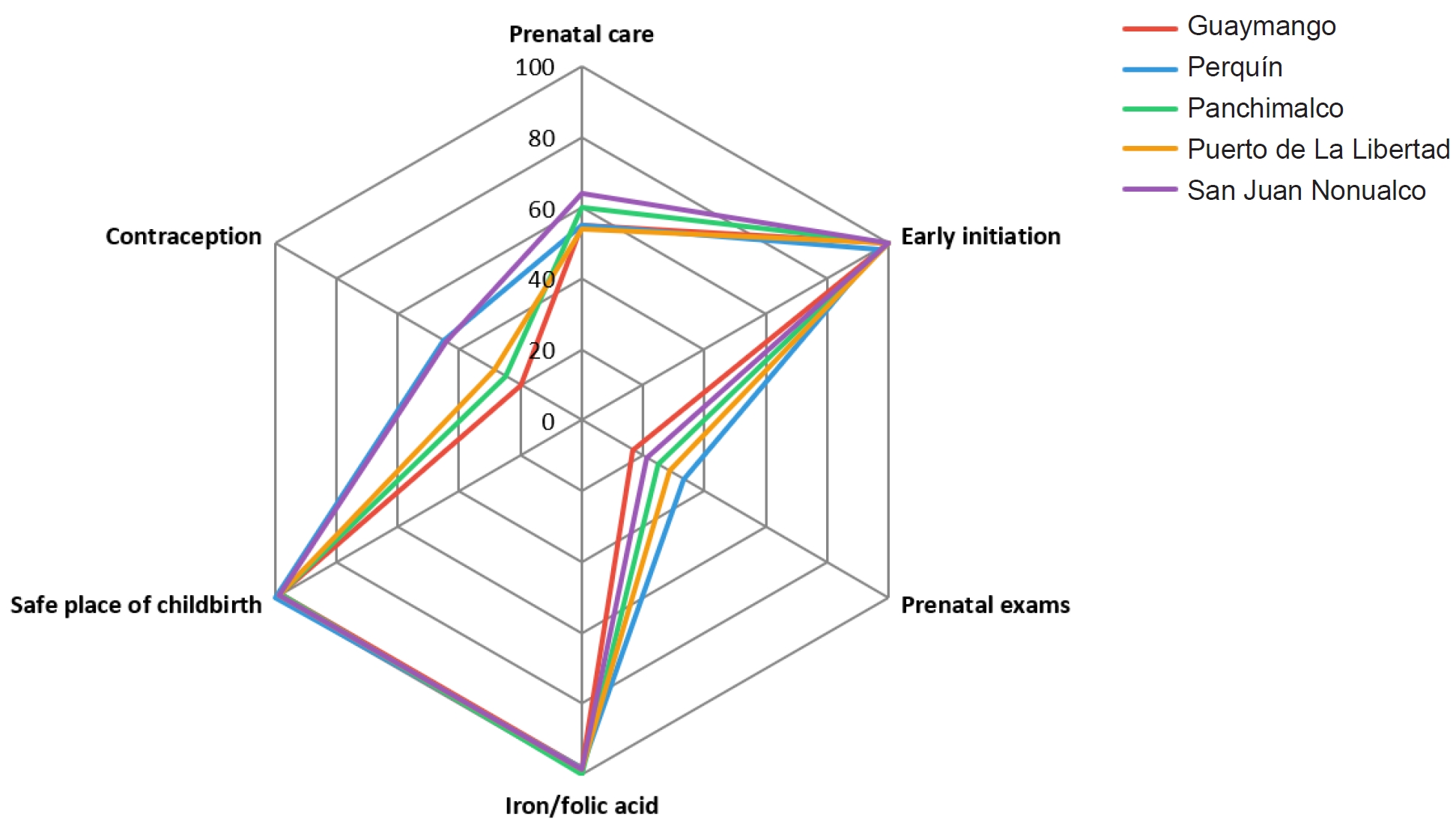
Profile of adequate knowledge by family community health unit (%).
Correlations between domains and nutritional profile
Spearman correlation analysis revealed two clusters among knowledge indices (Supplementary Table 4), suggesting that interventions in one domain may generate effects in correlated domains. The nutritional profile showed moderate dietary diversity (mean 4.96/7 groups) with low consumption of healthy fats (31.9%) and protein reduction in 24.3%. 45.4% reported disturbed sleep, with significant territorial variations (χ2=13.09, P=0.011) (Supplementary Table 5).
DISCUSSION
Attitudes were overwhelmingly favorable across all domains assessed. This should be read as a measurement ceiling rather than as a differentiating finding: agreement approached unanimity on every item, response style was highly homogeneous, and the scale therefore did not discriminate within this population. The substantive implication is nonetheless important. If attitudes are uniformly favorable while knowledge of technical content and several preventive practices remain deficient, the constraint on optimal maternal health outcomes in these territories lies at the structural level rather than the attitudinal one—a distinction with direct consequences for programme design, since interventions aimed at persuading women of the value of antenatal care address a barrier that these data do not identify.
To our knowledge, this is the first study in El Salvador to combine simultaneous measurement of KAP regarding antenatal care with systematic territorial disaggregation across multiple primary care facilities, statistical quantification of knowledge–practice gaps, and a baseline design with a pre-planned follow-up round. Earlier work in the country has addressed isolated components of this set, in single facilities or through review of unpublished academic literature [8,9]. The findings reveal a paradoxical pattern: almost universally favorable attitudes coexist with gaps in specific knowledge and with a notable dissociation between knowledge and practice.
Endorsement of the norm of early antenatal care initiation was near-universal in our sample (99.3%). This figure is not directly comparable with the composite knowledge scores reported in other KAP studies—96% with adequate knowledge in India [3], 84.1% with good knowledge in Eritrea [12] or 86.5% aware of antenatal care services in Somalia [5]—since those indices aggregate several items of technical content whereas ours reflects agreement with a single normative statement. What the comparison does suggest is that awareness of the value of antenatal care is not the limiting factor in this population, a conclusion consistent with the pattern reported in each of those settings, where favorable knowledge or attitudes coexisted with deficient practice.
Knowledge pattern: general strengths, specific fragilities
Knowledge about the importance of antenatal care and its early initiation was almost universal (99.3%), surpassing KAP studies in India (96%) [3], Eritrea (85.1%) [12], and Somalia (86.5%) [5]. However, only 25% had adequate knowledge about essential prenatal tests and merely 18.1% comprehensively understood the function of iron and folic acid. This pattern—where women internalize the message to “attend care” but lack technical understanding—has been described as the “coverage-knowledge gap” and documented in Mexico [13], where women received only 67.7% of necessary clinical actions despite high coverage. Correlation analysis revealed groupings among indices, supporting an integrated prenatal education approach in line with WHO recommendations.
Educational level as a structural determinant
Educational level was the only factor significantly associated with knowledge about prenatal tests (P<0.001) and contraception (P<0.001), consistent with international literature [3,14]. In contrast, age was not associated with any indicator (all P>0.19), suggesting homogeneous knowledge distribution across age groups, possibly reflecting the effectiveness of reproductive health campaigns. This result contrasts with studies in India [3] and Somalia [5] where age was a significant predictor.
The knowledge-practice gap
The most relevant finding is the quantification of knowledge-practice gaps. In contraception, 34.2% never used contraceptives despite 96.1% having knowledge (χ2=14.6, P=0.002), a phenomenon also documented in India [3].
The tetanus findings distinguish between two forms of knowledge with markedly different associations. Knowing why the vaccine is given showed no association with having received it, whereas knowing how many doses are required was strongly associated with vaccination status, following a monotonic gradient. The most instructive contrast lies at the lower end of that gradient: women who believed a single dose to be sufficient had the lowest coverage of any group in the sample (16.7%), below even those who reported not knowing (23.6%). A specific incorrect belief was thus associated with poorer practice than the absence of any belief, which is consistent with the interpretation that women who consider the schedule already complete have no reason to return.
This pattern suggests that awareness of the rationale for maternal immunisation is not by itself sufficient, and that the schedule is the more actionable target for health education in these settings. The finding should be interpreted with the caution appropriate to a cross-sectional design: women who have completed their vaccination series may also have had more opportunity to learn the schedule, and the direction of the association cannot be established from these data. Supply-side conditions, which we did not measure, may also contribute.
Favorable attitudes as a platform for action
Attitudes were overwhelmingly positive (>95%), surpassing studies in similar contexts (56%–89%) [5]. The coexistence of favorable attitudes with deficient practices suggests that barriers operate at the structural level, not attitudinal—a critical distinction for intervention design that must focus on facilitating access to services and commodities [4,15].
Territorial disparities
Territorial analyses revealed that some local differences are not evident in aggregate estimates. Although descriptive variations were observed across health facilities, statistically significant differences were identified only for selected indicators, while no significant differences were found in knowledge of prenatal tests. These findings suggest that geographically targeted interventions should focus on indicators showing demonstrated territorial variation. Because this study provides baseline evidence, future KAP surveys using the same questionnaire and knowledge indices should assess changes following program implementation. From a public health perspective, priority actions should strengthen health education on prenatal tests, iron and folic acid supplementation, tetanus vaccination, and postpartum contraception, while simultaneously addressing service-delivery barriers through improved follow-up systems, reminder mechanisms, vaccine availability, and counseling adapted to each UCSF.
Implications for public health intervention and evaluation
The present findings have important implications for maternal health programming in vulnerable and geographically isolated communities. First, educational interventions should move beyond promoting antenatal care attendance and focus on improving women’s understanding of the clinical purposes of prenatal examinations, iron and folic acid supplementation, tetanus vaccination, and postpartum family planning. Second, the substantial knowledge–practice gaps identified in this study suggest that educational efforts alone are unlikely to be sufficient. Strengthening service-delivery systems—including follow-up mechanisms, continuity of care, vaccine availability, reminder systems, and culturally appropriate counseling—may be equally important for improving maternal health behaviors. Finally, the considerable variation observed across UCSFs highlights the importance of context-specific intervention strategies rather than uniform approaches. Future maternal health programs should therefore combine educational, behavioral, and health-system interventions tailored to local needs and resource constraints.
Limitations
Limitations to consider: (1) the cross-sectional baseline design prevents causal inferences and cannot measure improvement over time without a follow-up survey; (2) self-report may be subject to social desirability bias; (3) the study population consisted of women in active contact with the participating facilities, and the sampling frame therefore excluded women residing in the same municipalities who do not use these services. This is a limitation of external validity: the findings characterize women already reached by the health system rather than the full population of women of reproductive age in high-risk areas. The likely direction of this bias can be reasoned. Nationally, approximately one in nine women with a recent live birth reports no antenatal care contact, and evidence from the region indicates that women outside the system are disproportionately of lower educational attainment and greater geographical isolation. Because educational attainment was the only sociodemographic characteristic significantly associated with knowledge in our sample, the knowledge gaps reported here are likely to be conservative estimates of those present in the full population of the five municipalities; (4) the sample size per facility (n≈60) limits power for specific subgroups; (5) non-response rate was not systematically recorded; and (6) declarative knowledge was assessed, not functional understanding. Future studies should incorporate pre-post or longitudinal designs, and may benefit from mixed-methods interviews to deepen understanding of contextual barriers.
(7) Selection within strata combined probabilistic selection from community registers with consecutive enrolment at the facilities; the design is therefore not a fully probabilistic sample of eligible women in each catchment area, and the facility component may over-represent women with greater ease of access to services. Refusals and non-contacts were not systematically recorded, so a participation rate cannot be reported.
Pooled estimates were not weighted by the population served by each facility. In addition, the home-visit modality recruited participants within rural communities, which may introduce a degree of intra-community correlation that was not quantified.
Associations between sociodemographic characteristics and knowledge were examined with unadjusted bivariate tests; the instrument did not include a direct measure of socioeconomic position, so residual confounding cannot be excluded. Where no association was detected, CIs were wide and do not exclude moderate differences; (8) This study involved multiple statistical comparisons, which may increase the probability of type I error. Therefore, additional sensitivity analyses using correction procedures for multiple comparisons were performed. Although some associations were attenuated after correction, the principal findings remained consistent, supporting the overall interpretation of the study;(9) Sensitivity analyses comparing currently pregnant and postpartum participants showed no significant differences in any of the six knowledge indices. However, receipt of two or more tetanus vaccine doses differed between the groups because vaccination schedules are necessarily incomplete for ongoing pregnancies. Consequently, this indicator should be interpreted with caution. Additionally, recruitment modality (facility versus community) could not be evaluated because this information was not recorded in the final dataset.
Conclusions
This baseline study among women attending five UCSFs in high-risk municipalities of El Salvador showed that high utilization of antenatal care services does not necessarily translate into adequate maternal health knowledge or optimal preventive practices. While awareness regarding the importance of antenatal care was nearly universal, important deficiencies remained in technical knowledge related to prenatal examinations, micronutrient supplementation, and reproductive health. Educational attainment emerged as the principal determinant of maternal health knowledge, whereas age showed no significant association.
Significant knowledge–practice gaps were identified, particularly in contraception and tetanus vaccination, suggesting that improvements in maternal health outcomes will require not only educational interventions but also the reduction of structural and service-delivery barriers. The observed territorial disparities further emphasize the need for locally tailored maternal health strategies.
Taken together, these findings provide important baseline evidence for maternal health programming in vulnerable communities of El Salvador and establish a benchmark for future monitoring and evaluation of the KOICA-supported maternal and neonatal health project. Future follow-up surveys using the same methodology will enable assessment of changes in KAP, and service utilization over time.
Supplementary material
Methodological basis for the construction of knowledge indices. Describes construction criteria, categorization thresholds, and technical rationale (WHO/Ministry of Health of El Salvador) for the six knowledge indices used in the study.
Sociodemographic and obstetric characteristics of participants
Association between educational level and age group with knowledge and practice indicators
Key KAP indicators disaggregated by health facility
Spearman correlations between knowledge indices
Nutritional profile and well-being of participants
Notes
AUTHOR CONTRIBUTIONS
Dr. Byung Wook YOO had full access to all of the data in the study and takes responsibility for the integrity of the data and the accuracy of the data analysis. All authors reviewed this manuscript and agreed to individual contributions.
Conceptualization: BWY. Data curation: EC. Formal analysis: EC. Funding acquisition: BWY. Investigation: EC. Methodology: YHK. Project administration: BWY. Supervision: YHK and BWY. Writing–original draft: EC. Writing–review & editing: all authors. All authors read and approved the final manuscript.
CONFLICTS OF INTEREST
No existing or potential conflict of interest relevant to this article was reported.
FUNDING
Funded by KOICA under the project “Strengthening the Maternal-Neonatal Emergency Transport System in Remote High-Risk Areas of El Salvador,” implemented by Soonchunhyang University Hospital and ERAK Consultores. The funder had no role in study design, data collection, analysis, or manuscript preparation.
DATA AVAILABILITY
The datasets are available from the corresponding author upon reasonable request. The instrument and methodological basis are included as supplementary files.
ACKNOWLEDGMENTS
The authors thank the participating women, staff of the five UCSFs, community health promoters, and the survey team. The support of Ministry of Health of El Salvador (MINSAL) in technical validation of the instrument is acknowledged.