Occupational Stress, Work-Life Balance, and Intention to Stay among Nurses during the COVID-19 Pandemic: A Cross-Sectional Study
Article information

Abstract
Background
This study examined the levels of occupational stress, work-life balance, and intention to stay among nurses working at tertiary hospitals during the COVID-19 pandemic, and investigated the associations among these variables.
Methods
This descriptive correlational study included 240 nurses working at a tertiary general hospital. Data were collected on participants’ general characteristics, occupational stress, work-life balance, and intention to stay. Descriptive statistics, t-tests, one-way analysis of variance, Pearson’s correlation coefficients, and multiple regression analysis were performed to examine the associations among occupational stress, work-life balance, and intention to stay while adjusting for participants’ general characteristics.
Results
The mean age was 27.85 years, and the mean clinical experience was 4.23 years. Half of the participants had experience caring for patients with COVID-19. Mean scores for occupational stress, work-life balance, and intention to stay were 87.51, 87.34, and 29.99, respectively. Occupational stress was negatively correlated with work-life balance (r=–0.41, P<0.001), whereas neither occupational stress nor work-life balance was significantly correlated with intention to stay. Multiple regression analysis showed that age was associated with intention to stay (β=0.19, P=0.029), but the model explained only 3.2% of the variance (adjusted R2=0.03).
Conclusions
Occupational stress and work-life balance were not significantly associated with intention to stay among nurses during the COVID-19 pandemic. Although age was significantly associated with intention to stay, the regression model explained only a small proportion of the variance. Further studies are needed to identify additional factors associated with nurses’ intention to stay.
INTRODUCTION
In public health crises such as infectious disease outbreaks, the workload and psychological stress of healthcare professionals increase significantly. In particular, continuous exposure to infection risks, the use of personal protective equipment, and high work intensity act as major factors that exacerbate physical and mental fatigue among healthcare professionals. This phenomenon was most notably observed during the Coronavirus Disease-19 (COVID-19) pandemic, which began in December 2019 and spread globally [1-3]. At that time, healthcare workers were reported to have experienced high levels of stress and workload while simultaneously performing infection prevention and patient treatment. In Korea as well, high levels of stress and burnout among healthcare workers were reported during the spread of COVID-19 due to excessive workload, staffing shortages, and exposure to infection risks [1,4]. Particularly in the context of infectious disease response, recurring staff shortages and increased workloads make maintaining an adequate nursing workforce a critical challenge. Therefore, sustaining nurses’ intention to stay is essential for maintaining workforce stability and ensuring continuity and quality of patient care during public health emergencies.
Nurses’ intention to stay in their current nursing profession refers to the intention to stop seeking other jobs or to stay in the nursing profession. Intention to stay is a motivating factor for positive behaviors toward employment [5-7]. Unlike turnover intention, which reflects an employee’s intention to leave the organization in response to unfavorable working conditions, intention to stay represents a positive psychological willingness to remain and continue contributing to the organization. Accordingly, intention to stay is recognized as an important indicator of nursing workforce sustainability.
Although turnover intention has been extensively investigated among nurses, relatively few studies have specifically examined intention to stay [8,9]. According to some prior studies, nurses’ intention to stay is reported to be influenced by various factors such as clinical experience, marital status, department, occupational stress, and work-life balance [9-12]. However, evidence regarding the direct relationship between occupational stress, work-life balance, and intention to stay remains limited, particularly during public health crises such as the COVID-19 pandemic.
Occupational stress refers to the physiological and psychological burden experienced during the course of work, and it has been reported that nurses experience higher levels of occupational stress than other healthcare professions [13]. In particular, nurses who cared for COVID-19 patients were found to have experienced high work burdens and stress [14,15]. Work-life balance is a concept that refers to the harmony between an individual’s life and work [16], and it has been reported that Korean nurses have a lower level of work-life balance compared to other professions due to shift work, night work, and holiday work [17]. In the context of infectious disease outbreaks, occupational stress may increase and work-life balance may deteriorate, potentially reducing nurses’ intention to stay and threatening workforce stability.
Given that intention to stay and turnover intention may reflect different psychological and organizational processes, findings from turnover intention studies cannot necessarily be generalized to intention to stay. Furthermore, empirical evidence regarding these relationships during public health emergencies such as the COVID-19 pandemic remains limited. Therefore, this study aims to identify the levels of occupational stress and work-life balance among nurses at tertiary hospitals during the COVID-19 pandemic, and to examine the relationships among occupational stress, work-life balance, and intention to stay. The findings are expected to provide evidence for developing strategies for promoting nurses’ intention to stay during future infectious disease outbreaks.
METHODS
Study design
This study is a descriptive correlational study designed to analyze occupational stress, work-life balance, and intention to stay among nurses working at tertiary hospitals during the COVID-19 pandemic and to examine the associations among these variables.
Description of participants
The participants were nurses working at tertiary general hospitals. The sample size was calculated using G*power version 3.1.9.7. With a significance level of .05, a medium effect size of 0.15, and a power of 0.95, and 9 predictor variables (2 independent variables and 7 general characteristics) were entered into the calculation. The required sample size for multiple regression analysis was 166. Considering a potential 40% dropout rate during the COVID-19 pandemic, 240 nurses were recruited. All 240 questionnaires were completed and included in the final analysis, with no dropouts.
Measurements
Occupational stress
The Korean version of the Expanded Nursing Stress Scale developed by Kim et al. [18] was used to measure nurses’ occupational stress. This scale consists of nine domains comprising 48 items. Responses were rated on a 5-point Likert scale ranging from 0 (“I have not experienced this situation”) to 4 (“I am always stressed”), with higher scores indicating higher occupational stress. Cronbach’s α was 0.95 in the original study [18] and 0.96 in this study.
Work-life balance
Work-life balance among nurses was measured using the Work-Life Balance measurement tool developed by Kim and Park [19]. The tool consists of four domains and 29 items. Responses were rated on a 7-point Likert scale ranging from 0 (“not at all”) to 6 (“very much so”). Cronbach’s α was 0.93 in the original study [19] and 0.96 in this study.
Intention to stay
Intention to stay was measured using the Nurses’ Retention Index developed by Cowin [20] and translated by Kim [21]. The tool consists of six items and is measured on an 8-point Likert scale ranging from 1 point (“not at all”) to 8 points (“very much so”), with higher scores indicating a higher intention to stay. Cronbach’s α was 0.97 in the original study and 0.91 in this study.
General characteristics
General characteristics included age, gender, marital status, clinical experience, position, department, and experience caring for patients with COVID-19, which were treated as covariates in the analysis.
Data collection
Data were collected from October 1 to October 31, 2022, after obtaining approval from the Institutional Review Board (IRB) of Gachon Gil Medical Center (IRB: No. GAIRB 2022-269). After obtaining cooperation from the nursing department of a tertiary general hospital, the necessity and purpose of the study were explained to the participants in writing, and questionnaires were distributed. Completed questionnaires were sealed in envelopes, deposited in a collection box, and retrieved by the researcher 2 weeks later. Participants provided written informed consent before participation.
Data analysis
The collected data were analyzed using IBM SPSS/WIN version 22.0 (IBM Corp.). Descriptive statistics were used to summarize the participants’ general characteristics, occupational stress, work-life balance, and intention to stay. Differences according to participants’ general characteristics were analyzed using the independent t-test and one-way analysis of variance (ANOVA). Pearson’s correlation coefficients were calculated to examine the relationships among occupational stress, work-life balance, and intention to stay. Multiple regression analysis was performed to examine the associations between occupational stress, work-life balance, and intention to stay after adjusting for participants’ general characteristics.
Ethical statements
The study was approved by the IRB of Gachon Gil Medical Center (IRB: No. GAIRB 2022-269) of the university hospital to which the researcher belongs. In accordance with COVID-19 prevention guidelines, all study information and consent procedures were provided in writing. Confidentiality and anonymity were maintained throughout the study. Participants who completed the questionnaire received a small token of appreciation.
RESULTS
General characteristics of the participants
A total of 240 participants were included in this study, with a mean age of 27.85±5.09 years. The majority of participants were aged 20–29 years (78.3%). Women accounted for 214 (89.2%) of the sample. Most participants were unmarried (n=215, 89.6%). The mean clinical experience was 4.23±5.14 years. Regarding position, the majority were staff nurses (n=219, 91.2%). In terms of department, 165 participants (68.8%) worked in medical wards. Half of the participants (n=120, 50.0%) had experience caring for patients with COVID-19 (Table 1).
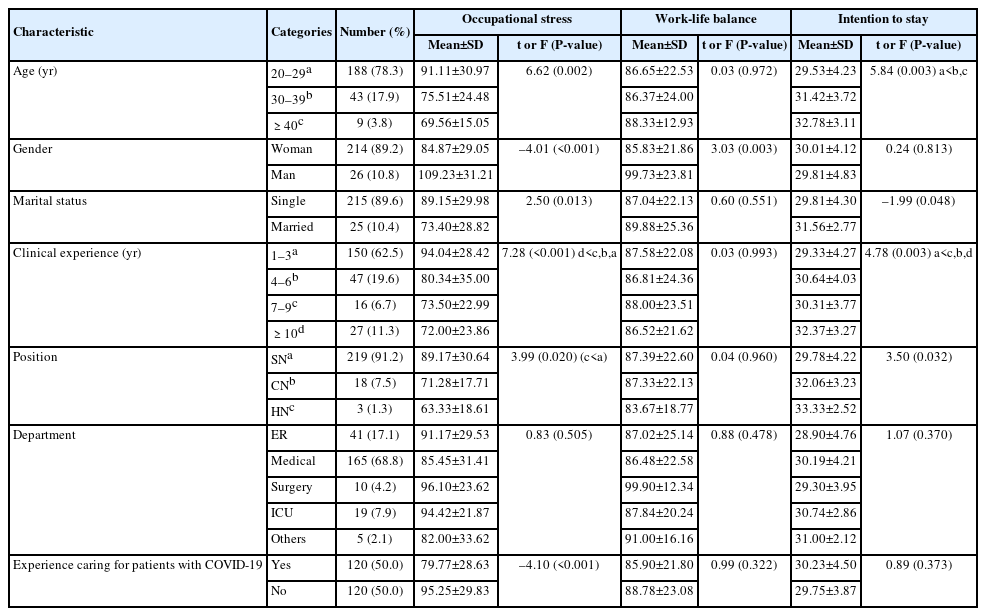
Differences in occupational stress, work-life balance, and intention to stay according to general characteristics (N=240)
Differences in occupational stress, work-life balance, and intention to stay according to general characteristics
Regarding occupational stress, younger participants (F=6.62, P=0.002), men rather than women (t=–4.01, P<0.001), unmarried participants rather than married participants (t=2.50, P=0.013), those with less clinical experience (F=7.28, P<0.001), those in lower positions (F=3.99, P=0.020), and those without experience caring for patients with COVID-19 (t=–4.10, P<0.001) reported higher levels of occupational stress. In terms of work-life balance, men reported significantly higher levels than women (t=3.03, P=0.003). Regarding intention to stay, higher levels were observed among older participants (F=5.84, P=0.003), married participants compared with unmarried participants (t=–1.99, P=0.048), those with greater clinical experience (F=4.78, P=0.003), and those in higher positions (F=3.50, P=0.032) (Table 1).
Relationships of occupational stress, work-life balance, and intention to stay
The mean occupational stress score was 87.51±30.19, the mean work-life balance score was 87.34±22.45, and the mean intention to stay score was 29.99±4.19 (Table 2). Occupational stress showed a significant negative correlation with work-life balance (r=–0.41, P<0.001). No significant correlation was found between occupational stress and intention to stay (r=–0.09, P=0.164) or work-life balance and intention to stay (r=0.02, P=0.810) (Table 3).
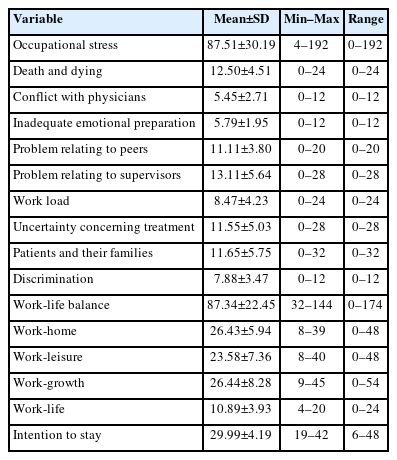
Occupational stress, work-life balance, and intention to stay (N=240)
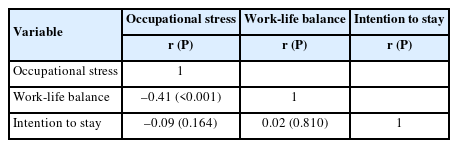
Correlation of occupational stress, work-life balance, and intention to stay (N=240)
To examine the associations between occupational stress, work-life balance, and intention to stay, multiple regression analysis using the enter method was conducted (Table 4). The Durbin–Watson statistic was 2.26, indicating no autocorrelation of residuals. Tolerance values ranged from 0.56 to 0.79 and variance inflation factors ranged from 1.27 to 1.78. Occupational stress, work-life balance, and general characteristics that showed significant differences—age, marital status, clinical experience, and position—were included in the model after dummy coding. The results of the multiple regression analysis indicated that age was the most significant factor associated with intention to stay (β=0.19, P=0.029). The model explained 3.2% of the variance in intention to stay (adjusted R2=0.03), and the overall model was statistically significant (F=2.33, P=0.033).
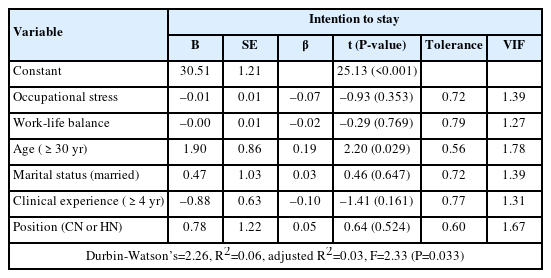
Multiple regression analysis of factors associated with intention to stay (N=240)
DISCUSSION
This study examined the relationships among occupational stress, work-life balance, and intention to stay among nurses working at tertiary hospitals designated for COVID-19 care during the pandemic. Overall, occupational stress was negatively associated with work-life balance, whereas neither occupational stress nor work-life balance was significantly associated with intention to stay.
First, the level of occupational stress observed in this study was moderate, differing from previous studies that reported high levels of stress and burnout among nurses during the early stages of the COVID-19 pandemic [22-24]. Unlike earlier studies conducted during periods of greater uncertainty [25], this study was performed after infection control systems had become more stable and nurses had adapted to new clinical routines, including the use of personal protective equipment, which may explain the relatively lower level of occupational stress observed. Nurses with experience caring for patients with COVID-19 also reported lower occupational stress. Additional analyses of the present data indicated that nurses with experience caring for patients with COVID-19 were generally older and had longer clinical experience than those without such experience. This finding may reflect greater clinical competence, accumulated coping skills, and adaptation to infection-control practices among experienced nurses [26-29]. However, because the present study did not directly compare nurses with and without COVID-19 patient care experience, this explanation remains speculative and should be interpreted with caution. Further studies are needed to verify this finding.
Regarding specific stressors, discrimination and problems with peers were identified as the most prominent sources of occupational stress. This differs from previous studies emphasizing workload or physician-related conflict [30]. Frequent staff redeployment and rapid reorganization during the pandemic may have increased interpersonal conflict and disrupted team dynamics [26-28]. These findings suggest that healthcare organizations should address interpersonal and organizational factors as well as workload during future public health emergencies.
Second, work-life balance was relatively high compared with previous studies conducted during the pandemic [31]. This finding may be related to the characteristics of the study sample, which consisted largely of younger nurses with relatively short clinical experience. Early-career nurses may have fewer family responsibilities and greater flexibility in balancing work and personal life [32]. As expected, occupational stress was negatively associated with work-life balance, consistent with previous research [28,32-33]. These findings suggest that reducing occupational stress may also improve nurses’ work-life balance.
However, neither occupational stress nor work-life balance was significantly associated with intention to stay. Previous studies have primarily focused on turnover intention rather than intention to stay, making direct comparisons difficult [29,34,35]. One possible explanation is that turnover intention and intention to stay are conceptually distinct constructs. Therefore, occupational stress and work-life balance may have different relationships with intention to stay than with turnover intention. However, the present study was not designed to identify other determinants of intention to stay. Previous systematic reviews have identified several organizational and psychological variables that may be associated with nurses’ intention to stay. However, these variables were not examined in the present study. The regression model explained only a small proportion of the variance in intention to stay (adjusted R2=0.03), suggesting that additional factors beyond occupational stress, work-life balance, and the variables included in this study should be investigated in future research. Third, age was the only variable significantly associated with intention to stay. However, because the regression model explained only a small proportion of the variance, age alone is unlikely to account for nurses’ decisions to remain in their organizations.
From a practical perspective, strategies to promote nurses’ intention to stay should comprehensively address both organizational and individual factors beyond age alone. Interventions aimed at reducing occupational stress may also improve work-life balance. During infectious disease outbreaks, workforce management should consider not only workload but also staff experience and the need for adaptation support in unfamiliar clinical environments. Although the COVID-19 pandemic has ended, nursing shortages and workforce instability remain global challenges. The present findings suggest that improving occupational stress or work-life balance alone may not be sufficient to enhance nurses’ intention to stay. Because the present study did not examine organizational determinants, future studies should investigate organizational and psychological factors that may contribute to nurses’ intention to stay.
Despite these contributions, this study has several limitations. The findings were obtained from a single institution, and the sample was largely composed of early-career nurses, which may limit generalizability. In addition, the cross-sectional design precludes causal inferences. Future studies should include more diverse samples across multiple institutions, incorporate broader organizational and psychological variables, and use longitudinal or qualitative approaches to better understand nurses’ decisions to remain in their organizations.
In conclusion, occupational stress and work-life balance were not significantly associated with nurses’ intention to stay in this sample. Although age showed a significant association with intention to stay, the regression model explained only a small proportion of the variance. These findings suggest that additional factors influencing nurses’ intention to stay should be explored in future studies.
Notes
AUTHOR CONTRIBUTIONS
Dr. Young KO had full access to all of the data in the study and takes responsibility for the integrity of the data and the accuracy of the data analysis. All authors reviewed this manuscript and agreed to individual contributions.
Conceptualization: SHK, YK, and MJJ. Data curation: KHM and SHK. Formal analysis: all authors. Methodology: all authors. Software: YK and MJJ. Writing–original draft: all authors. Writing–review & editing: all authors.
CONFLICTS OF INTEREST
Young KO is the Associate Editor of this journal and was not involved in the peer review or editorial decision-making process for this article. No other potential conflicts of interest relevant to this article were reported.
FUNDING
None.
DATA AVAILABILITY
The data presented in this study are available upon reasonable request from the corresponding author.
ACKNOWLEDGMENTS
We would like to thank all the nurses who participated in the research during the COVID-19 pandemic.